Review: Wilde Stories 2009: The Year's Best Gay Speculative Fiction

Wilde Stories 2009: The Year's Best Gay Speculative Fiction
Edited by Steve Berman
Published by
Lethe PressReviewed by Paul Kane
These eleven stories display a match made in heaven and, on occasion, consummated in hell: speculative / slipstream literature conflated with a queer/LGBT sensibility. Joel Lane’s Behind the Curtain, a skewered take on the vampire tale, is a case in point. Set amid a landscape of urban decay and environmental collapse, it has a protagonist intent on cruising for a bruising; or a bloodletting, anyway. Vampire romance, as a genre, is all the rage with adolescent girls at the minute; this story is a more carnal version of the form.
The most impressive piece of fiction is AKA St. Mark’s Place by Richard Bowes, though the ending is a bit perfunctory, mind. In essence, the story traces the relationship between three troubled souls - Judy, Ray and BD - from the mid-'60s to the early 1970s. Their relationship, a tangle of fate, is not so much a love triangle as a triangle of intimate complicity; and the most effective passages evoke the frisson of feeling that occurs when you notice properly who people are, how they see themselves. The clairvoyant element here adds a layer of mystery, but does not dispel the gloom of two take-home truths: families are ramshackle dwellings, unstable and insecure, is one; another: the abused will somehow tend to become abusers.
Another highlight of the collection is a tale entitled Bluff, by that formidably accomplished writer, L.A. Fields. His contribution touches on lust, longing, a little death (in the Elizabethan sense, natch) and maybe the larger one. Though a small example of what he can do, it is effective nonetheless.
Finally, to end, comments on a couple of other contributions. I’m Your Violence by Lee Thomas starts out as a police procedural in the vein of James Ellroy: a grisly sex murder, the leading turn an act of near-cannibalism. It then veers off in a weird (or an even weirder) direction but a fruitful one, with an interesting moral ambivalence at its core. As a writer, Thomas is a real find and his protagonist here, a detective by the name of Dean Kaiser, is surely too intriguing a character to be limited to a run-out in just one story. Echo by Peter Dube is different again, having a thread of subtle disquiet which evokes that dark genius Thomas Ligotti, or some of the rare fictions of Guy Davenport. It seemed to tell of a curious fate, yet was as much a meditation on memory and lost time. A strange, suggestive story.
Paul Kane lives and works in Manchester, England. Hewelcomes responses to his reviews and you can reach him at ludic@europe.comLabels: Anthology, Review
Review: Fifty Gay and Lesbian Books Everybody Must Read

Fifty Gay and Lesbian Books Everybody Must Read
Edited by Richard Canning
Published by
Alyson Books
Reviewed by Max Fincher
‘Must read’ or ‘must do’ lists rouse my hackles, initially at least. My immediate feeling is: ‘Why must I?’ Why should I read this or that book in preference to another? Or one I have chosen to read or had recommended to me? It is similar to the mixed feelings you might experience being told to read certain ‘classic’ works of fiction at college or university, because they are somehow inherently ‘good for you’. We all know what is good for us (sometimes we even enjoy it) but we don’t always necessarily want to be good all the time. However, this collection of essays in no way attempts to persuade you why you must read these books along the arguments of their literariness, popularity or for self-improvement reasons; in fact, one or two of the essays argue against reading their choice. Instead, the reader is given very personal reflections by the contributors on the pleasures they have yet to discover. After putting off reading Moby Dick for years, I might now try reading the novel, as well as revisiting again, with a better understanding, Djuna Barnes’s Nightwood.
So Fifty Gay and Lesbian Books Everybody Must Read ‘...isn’t a canonical book’. As Richard Canning makes clear in his introduction, there is no overarching grand narrative that links the selections together according to some linear, developmental history. The range of books covered is not merely limited to novels either. Letters, diaries, poetry, and autobiography are included, and the essays span Plato, Gilgamesh and the Bible to contemporary fiction by Herve Guibert, Rebecca Brown and Matthew Sadler. This is not intended to be a comprehensive survey or history of gay literature in the manner of say Gregory Woods’s A History of Gay Literature, but is a highly subjective and personal choice of works by both new and established contemporary writers. There are gaps and holes between writers and periods and ‘the babble of gathered voices’, gaps that we can fill in if we choose. Inevitably, everyone will have their own ‘must read’ list. But as Canning says to focus on who is left out is to miss the point: ‘the value of this book not by what isn’t here, but by what is’ (p.xiv).
And for some readers there may be surprising omissions. Forster, Gide, Genet, Joe Orton, Armistead Maupin, Alan Hollingshurst and Sarah Waters are all absent. One aspect of this collection that makes it immensely readable and enjoyable, is that the essays are not consistently in the vein of classic biographical or literary-critical appreciations. Instead, many contributors offer subjective viewpoints, reminiscences and musings on the process of reading, the writers or describe how certain characters changed or affected them personally. Many essays read against established interpretations. For instance Robert Glück’s reads Edmund White’s, A Boy’s Own Story as a transgressive piece of fiction that argues against reading the novel as an example of ‘crossover’ literature with mainstream audiences. Regina Marler admits she doesn’t like Henry James’s The Bostonians, finding James’s characterisation of the latent lesbian attraction between the characters of Olive and Verena ‘mean-spirited’, ‘spiteful’ and ‘grotesque’.
Frequently, the essays are stylistically inventive, as in Kathy Acker’s appreciation of the fiction of William Burroughs. In addition, there are exciting cross-currents occurring between readers and writers, where sexuality is not a centrifugal point: straight and lesbian women read gay men’s writing, and (previously straight) and gay/bisexual men read straight women’s fiction. The essay by Mark Behr on The Color Purple is a shining example, and shows the power of fiction to both transform and connect people.

Herman Melville
Out of the fifty books chosen, I have read six: Horace Walpole’s Letters (only selections; reading all thirty-four volumes would take forever); Evelyn Waugh’s Brideshead Revisited; James Baldwin’s Giovanni’s Room; Mary Renault’s The Persian Boy; Alice Walker’s The Color Purple and Jeanette Winterson’s Oranges are Not the Only Fruit. For my Christmas holiday reading, I decided I would choose five books to read. Vestal McIntyre’s description of Herman Melville’s Moby Dick as ‘...a story bursting at its seams, assembled and sewn together as roughly as Frankenstein’s monster’ and Melville’s daring, experimental language intrigues me. I have shied away from modernist fiction, but perhaps Melville will engage me. Second on my list is Marguerite Yourcenar’s Memoirs of Hadrian. Edmund White describes how Yourcenar’s had an unconventional upbringing, tutored by her father in Latin and Greek, and how she is ‘a philosophical writer with a deep and wide culture’. I am hoping to discover a brilliant historical fiction writer, to see how she portrays ‘one of the great same-sex love stories of all time’. Thirdly, I would like to read Allen Ginsberg’s Howl and Other Poems. David Bergman has whetted my interest by describing Ginsberg’s curious mix of spirituality and explicit sexuality, his inclusive and embracing attitude to other people, and how the experience of reading his poems is like ‘holding the book and holding the man’. J.R. Ackerley’s autobiography, My Father and Myself, is, according to Andrew Holleran, ‘a wonderful comic portrait of people with an almost Dickensian cast’. I am anticipating from Holleran’s description something in the realm of Alan Bennett’s wonderfully observant character-sketches, Talking Heads, mixed with Kenneth Williams’ diary. Holleran’s description of Ackerley as ‘entertaining’, ‘acerbic’ and ‘never boring or monotonous’, suggests a pleasurable journey of exploration of a complex man’s relationship with his father and his own sexual feelings. Finally, I would like to read Andrew Holleran’s own novel, Dancer from the Dance, to submerge and lose myself in a heady era of ‘intense artifice’, the disco moment of the 1970s, and to discover perhaps the ‘first real novel of Gay Liberation’, which as Matias Viegener says is ‘a wild and unexpected fulfilment of Walt Whitman’s utopian call for the “love of comrades” to “sing the body electric”.
Reading the essays in this collection has opened my eyes to the diversity of voices and his(her)stories that are out there for us all to explore and experience. You may find your assumptions and expectations about a particular work or writer confirmed or overturned, but hopefully you will make new discoveries. I am hoping my own selections will be entertaining, challenging and informative, and that each will contain something that, in some small or large way, changes my own ‘certainties’. To this end, I would like to conclude with a quotation from Mark Behr’s essay on The Color Purple, as a coda for why everyone must read:
The Reader doubts, often. From book to book, his doubts multiply. The Reader believes that if more people were less certain more often, and tasted the emancipation that comes with doubt, there would be fewer wars and fewer hungry and unhappy and angry people in whose eyes he sees himself reflected.
Max Fincher wrote his PhD at King’s College London, a queer reading of late eighteenth-century Gothic fiction that was published as Queering Gothic Writing in the Romantic Age by Palgrave Macmillan (2007). He has taught part-time on eighteenth-century fiction and women’s writing, at both King’s College London and Royal Holloway, and is an occasional book reviewer for the TLS. He is currently writing his first novel, tentatively titled The Pretty Gentleman, a queer historical thriller set in the Regency art world.Labels: Anthology, Review
Review: Ganymede Stories One

Ganymede Stories One
edited by John Stahle
Published by
GanymedeReviewed by Marc Bridle
This anthology brings together short stories published in the first six issues of Ganymede; and like all anthologies it is a hit-and-miss affair. But what sets it above many similar collections is both the quality of the writing and the audacity of its editors in establishing a new gay literary benchmark for anthologies of this kind. The (mostly) contemporary prose in these 200 pages is seen squarely in the context of a Nineteenth Century aesthetic, one that stretches from the horse-drawn hansoms of gas-lit London to the bloodshot-eyed edginess of modern day San Francisco and Paris.
From Andrew J. Peters’ adorably amusing gay fairytale, The Vain Prince, to Cyrus Cassells’ aphoristic Another Horse on Your Horse Ranch established principles of prose are overturned. Peters’ fairytale anti-hero, Adalbert, is rather like a queer Turandot, and his prose swaggers along like a drunken queen in a nightclub, the very antithesis of what a fairytale should be. The opposite are Cassells’ exquisitely drawn short paragraphs, dexterously poetic and dripping in color like a golden-tongued seraphim. Elsewhere you can clearly see an individual writer’s non-literary influences. B.R.Lyon’s As is, I aspires to the condition of music, as does Marc Andreottola’s Lots. What sets Andreottola’s story apart from others here is the filmic quality he brings to his narrative. Just as a filmmaker can focus on one image and make the viewer seem unsettled so does Andreottola: “All the entertainer could see was the thigh of the Stump, a strong meaty thigh. The thigh activated the entertainer somehow, like a switch. He felt like the thighs could crush him like a nutcracker.” On a completely different level, John Stahl’s brilliantly articulated Memories of Inexpression shows that evocative writing doesn’t need to be a dialogue. With Beckett-like precision Stahl’s prose bears the imprint of isolation and memory like few other pieces in this anthology.
Gay writing is universal and it is, therefore, good to see the Ljubljana-based writer Boris Pintar included in this anthology. Slavic Thicket: Two Stories, translated from the Slovene by Rawley Grau, is coruscating. Whether by design or by translation his writing positively reeks of scents; pissing is not so much about the act as it is about the smell. In fact, this is prose that assails the senses in every way: cocks are eye-balled, sniffed and licked; nostrils are there not just to smell the aphrodisiac of sex but to snort coke, poppers and glue. Paragraphs are long – but never over long – but their very tightness leaves one feeling rather as if one has been clubbed over the head. They are brutal. The only other story which comes close to this kind of semi-pornographic wasteland of spunk and hard fucks is Eric Karl Anderson’s Beauty Number Two.
There used to be a time when gay literature had one ubiquitous theme: HIV and AIDS (think especially of the works of Hervé Guibert or David Wojnarowicz) so it was astonishing to find that the acronym HIV appears twice and AIDS just once in this entire anthology, and even then in just one story: Beauty Number Two. Anderson is certainly neither quixotic nor passive about it (“I’ve had enough of this fucking AIDS death camp”) but neither is he remote from it (“He is HIV positive: each revelatory fact makes him more perfect in my fevered imagination”). And jostling with the poetry of Anderson’s prose is a veritable shopping list of modern-day triviality, from celebrity blow-jobs to branded underwear, all neatly bound together in a very Noughties framework of queer happiness.

Cyrus Cassells
Which is, I suppose, what Oscar Wilde and Robert Louis Stevenson might have been doing in the Nineteenth century. The inclusion of works by Wilde and Stevenson, taking up a full quarter of the pages here, strikes me as problematical, though it does underline the extent to which some recent gay writing has retrenched to a more inverted form of beauty. Neither author could be said to be a model for Dennis Cooper’s anti-queer deviancy, but I can see the partial influence of their aesthetic on some of the writers appearing earlier on in this collection. Stevenson’s The Adventure of the Hansom Cab is indeed evocative, but its links to anything gay are tenuous. It reminds me more of the subtle homoeroticism of a Mapplethorpe still life. Wilde’s Lord Arthur Savile’s Crime is more semi-comic than semi-erotic; it’s inclusion based on the assumption that it is a rarity amongst Oscar Wilde’s prose works is, I think, unfounded.
Nevertheless, their prominence in this collection doesn’t detract from the sheer overall quality of the writing elsewhere, which is uniformly of a high standard. The sharp-edged writing of these authors might have benefited from equally sharp writing to stand beside them – perhaps some Samuel R Delaney (unfamiliar to many, even in North America) or a translation of some of Pierre Guyotat’s Prostitution, for example. Production values are high, and similar in style to Ganymede’s quarterly journal. Lavish black and white photographs are interspersed throughout, including some of the authors - who tend for the most part to be an attractive bunch. A perfect stocking filler – or as Marc Andreottola might have put it in his story a “dirty black sock” filler.
Marc Bridle is a critic and writer. He is based in Vancouver and London.
Labels: Anthology, Review
Review: Second Person Queer

Second Person Queer: Who you are (so far)
Edited by Richard Labonte and
Lawrence Schimel
Published by
Arsenal Pulp PressReviewed by Eric Karl Anderson
Telling a story in the second person necessarily focuses the narrative voice as if the author were speaking to a particular person. Following on from the successful award-winning anthology First Person Queer, this collection gathers forty writers from wildly different perspectives writing essays directly to “you.” Many of the authors have chosen a specific type of individual who they are addressing ranging from macho bears, women throwing play parties, young bisexuals, Asian men in a predominantly white gay community or people who have recently come out. This direct approach makes the concerns which these multifarious voices are speaking of feel immediately relevant, even when you know that the “you” the author is addressing isn’t you specifically. These essays/letters/stories express a wide range of sometimes conflicting opinions. But each of the accounts in this lively, fascinating and provocative anthology speak strongly about how our ever-evolving identities are never stable. As the subtitle states, this anthology speaks about “who you are (so far).”
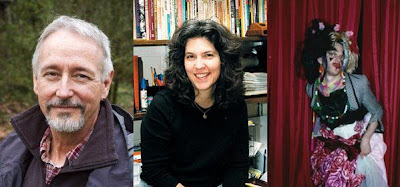 Some essays take the satirical stance of a pseudo-advice column advising you ‘why you should have sex on a first date’ or ‘how to date a married man.’ The tone of the latter by Lewis DeSimone gradually moves from an impersonal advice column to hinting at a moving personal story about falling for a man in a committed relationship when first coming out. Some essays are straightforwardly comical like Paul Bellini’s advice in ‘How to Survive Gay Celebrity: A Pocket Guide.’ Others are honestly heartfelt. Greg Herren gives sage advice about the importance of believing in yourself as an individual rather than letting “the negative eclipse the positive.” Alisa Lemberg and Jeff Mann give very practical advice about entering the BDSM scene and leather communities in ‘Leather Queer: Learning the Ropes’ and ‘How to Be a Country Leather Bear.’
Other entries present arguments about how “we” as queer people stand in relation to heterosexual society. Jay Starre defiantly states, “You are gay, for God’s sake, and don’t need to fit your love life into some pre-conceived cultural idea of what is right and what is wrong.” Lloyd Meeker elaborates in his essay how “you happen to love men because you are wired so differently than heterosexuals” and that as such we have a special spiritual mission. In some entries like Meeker’s, as with so many cultural discussions about being gay, these arguments are only really including male North American homosexuals. It’s fair enough to discuss only one part of the queer community as many of the entries do considering that each part has its own specific issues. However, in cases like this where political arguments are being made they might be more usefully opened out to discuss other sections of the population. Rest assured, the editors have been careful to include in the anthology a wide-ranging and balanced collection of voices from many different races, age-ranges, locations and genders.
Essays like Jane Van Ingen’s practical ‘How to Archive Our History’ and Victor J. Banis’ meaningful ‘How to Write and Live to Tell about It’ give a much more straightforward call to action, entreating us to document and preserve our experience for current and future generations of queer people to use as touchstones.
 A few of the essays moved me so powerfully with the intensity of their voices that I felt struck to the core and it’s made me read them over and over:
Mattilda Bernstein Sycamore writes a heartfelt letter and tribute to David Wojnarowicz and how his book mattered when Sycamore was literally trying to survive and “learning and living and giving the potential of embracing outsider status in order to create safety, love, community, desire, home on my own terms.” This is a testimony which recalls the sobering fact that so many in our queer community aren’t privileged enough to make it to the stage where they can deliberate all these issues about how to live queer lives.
Achy Obejas lists fifty ways to continue after a break-up. Each point suggests a multitude of stories which give you a sense of the many failed queer relationships which have occurred over the years. Funny, sad and true, this list encompasses a range of ways to end things and begin them again.
And Blair Mastbaum, immediately in the opening pages, questions whether being out necessarily means we should be proud in his startling essay ‘You Know You Know.’ When it’s become the queer orthodoxy that “gay is good” Mastbaum controversially questions whether this is so and, if we are not good individuals, are we merely celebrating a “genetic condition?”
Almost all of the essays contained in Second Person Queer are very short, many only two or three pages long. This makes it a fast-paced read, leaving the reader with an almost dizzying sense of the sheer diversity of what being queer is and how many different points of view there are about how we should live with the fact of our queerness. But this is the point. Like the editors state in their introduction, “SPQ collects a plurality of voices about a range of queer-interest topics, not always on the same page, but always with the same intention: to help you define (or, perhaps, decide) who you are.” This collection certainly achieved its goal in helping me to define and redefine myself. Perhaps Sean Michael Law puts it best in his letter ‘To My Thirteen-Year-Old Daughter Who Just Told Me She’s Bi,’ “being queer isn’t about being just one thing. It’s about understanding the harmony of all things, the necessity of difference and the careful ways that human lives integrate with one another.” Importantly, this is when all the profiling and queer labels break down and you understand finally that you are and always have been an individual.
Eric Karl Anderson is author of the novel Enough and has published work in various publications such as The Ontario Review, Harrington Gay Men’s Fiction Quarterly, Blithe House Quarterly and the anthologies From Boys to Men and Between Men 2.
Labels: Anthology, Review
Review: Between Men 2: Original Fiction by Today’s Best Gay Writers

Between Men 2
Edited with an Afterword by Richard Canning
Published by
Alyson BooksReview by Jonathan Statham
It has often struck me as somehow significant that the gay section in a mainstream bookshop (if it exists) often contains a high proportion of books which anthologise short stories. Many of these are of course erotica but there is besides this a healthy supply of collections like the one currently under review: anthologies of contemporary authors using fiction to engage with and be literate about gay life (contemporary and historical). Furthermore, in the current publishing climate, it is these books which seem most happy to label themselves ‘gay’ and to take homosexuality as their explicit subject matter. Why this is the case is perhaps more problematic. What does short prose have to offer that it should be such a staple for gay readers today?
From one point of view, there seems to be a general sense that to make homosexuality the explicit subject of a novel would be gratuitous – as the editor of the current volume, Richard Canning, put it in his Afterword: “some of us live in a world where being gay may prove no big deal”. Certainly, many of these stories do take as their starting point the notion that being gay is but a part of their characters’ lives. Yet it is the strength of these stories to betray that starting point, to demonstrate instead the pervasiveness of their characters’ (homo)sexualities, the ways in which their being gay affects every relationship they have, sexual and non-sexual.
Indeed, I think the most interesting stories here are those in which the ‘couple’ is not the strict focus, because it is then that the socially pervasive character of homosexuality gets brought out, the reasons why even if it is only one part of a life it is still always a big deal (not least because it is quite frankly a big deal to have a sexuality at all). To give a few examples: John Weir acutely assesses male friendships that, as it were, cross the orientation divide. Aaron Hamburger looks at a mother emigrating to be with her gay son in America and shows how sexuality and nationality and the creation of community are complexly interwoven and not always harmoniously. Then there is Eric Karl Anderson’s (he who is also the editor of this blog) intricate story of a father and son in which the son’s relationship with his own homosexuality and that of those around him impacts upon his relationship with his father. Wayne Koestenbaum’s piece is perhaps an even more extreme example, being a posthumous dialogue between Sylvia Plath and Rainer Werner Fassbinder who both, being dead, now reside in New Jersey – their conversation revolves around Fassbinder’s erection and is many ways a debate on the emotional nuances of sexuality and sexual acts. An exploration shared, as it were inversely, by David McConnell’s story in which the sexual nature of the relationship is precisely what is in question, specifically with regard to the prescribed sexual roles, top and bottom (“mindless concepts […] which eliminated all subtlety and all fine distinctions”). In each of these stories, and others in this volume, it is a question not of making homosexuality an issue but of examining what homosexuality puts in issue, how it changes the social dynamics, creates alternative possibilities in its departure from the normative. And this is one thing the short story can do best: show how an aspect, a significant detail, a part, transforms the whole.
 Patrick Gale, Richard Canning, Eric Karl Anderson
If that already sounds like the dynamic of gay liberation, its search by means of homosexuality for new socio-sexual formations, relations and communities that might free homosexuals, heterosexuals, bisexuals and the whole queer lot of us, then I think that is no accident. Furthermore, we might take the digression or departure from a focus on the conventional couple (that core model of heterocentric life and culture) negotiated by these stories as some kind of answer to a question posed to us recently by Peter Tatchell, writing in The Guardian on the eve of Stonewall’s fortieth anniversary: “are queers the new conservatives, the 21st-century suburbanites?” Well, almost we are, almost but not quite as this volume seems to bear testament. For while many of these stories take up domesticated life, they do so in order to unravel it, to reveal how it is striated not only by sexual orientations but also by race, gender, age, nationality and death and the intertwining of these things.
In addition to the stories themselves, Richard Canning has included an Afterword in which he gives us brief literary critical ‘readings’ of every story included in the volume (with the exception of one of the most striking stories, Koestenbaum’s dialogue already noted, which he mentions only in passing, possibly because his literary critical approach does not lend itself to a reading of a piece so unusual in form). However, these readings, insightful as they are, seem to do a disservice to both the stories and the reader neither of which in fact require an explanation or an interpretation (though the sense Canning sometimes provides of how the tale fits into the author’s corpus of work is certainly enlightening). The Afterword becomes interesting only as he concludes by beginning to question the collection itself, specifically “the diversity of voices and experiences collected here – and possible lack of it”. This leaves me immensely curious as to why Canning wanted to create this series of books in the first place and what he thinks the anthologisation of these writers might accomplish or work towards.
For, what I do not get, neither from Canning’s Afterword nor indeed from his selection of these specific stories, his bringing together of these particular pieces, is a sense of why this book is being made. The volume as whole, and this is no criticism of any of the individual stories, lacks a sense of purpose, a sense that it is trying to accomplish something. Of course, Canning is right when he asks “why have a set of requirements for fiction? Why “must” fiction do, or be, anything?” – except that neither ought it do or be nothing. In a particular instance it must indeed be something or we are left with a blandness, which in this case is grossly unfair to some exquisite short stories. This is not a question of establishing ‘requirements for fiction’ – certainly there is no single thing that fiction must always do – but an anthology (or any publication for that matter) is a situation for fiction in which an idea of fiction takes shape (and does so whether one intends this or not). But what Canning suggests in his Afterword is that this volume merely collects what he considers to be good writing by authors who only happen to be gay (among other things). Yet if this volume illustrates his idea of good writing then it obscures its own project as a gay collection and betrays the stories it collects. Having said that, it is noticeable that the authors are almost all novelists and it is clear to me that the short form is here neither explored for all its possibilities nor pushed to its limits to create new possibilities. Sometimes we are even given a chapter from a forthcoming novel. This seems a missed opportunity to me, as if the volume were willing its own ephemerality rather than seeking to make a genuine contribution to the ongoing process of gay culture and art through the development of form. Nevertheless, the stories here can be appreciated individually as accomplished works redolent of twenty-first century homosexuality’s search for its place and its meaning in a world ever more diverse, ever more complex and ever more changeable.
Jonathan Statham lives and writes in Manchester.Labels: Anthology, Review
Review: Bears – Gay Erotic Stories

Bears
Edited by Richard Labonte
Published by
Cleis PressReviewed by
Len Lukowska
What is a bear? This is something editor Richard Labonte ponders in his introduction to ‘Bears’. Apparently it’s about maturity and spirituality, and of course constructions of masculinity and the idea of being fucked/fucking a ‘real man’. OK, so that terminology annoyed me, and he didn’t really say ‘constructions of masculinity’, but I felt that’s what he meant. Anyways I’m ready to accept this book isn’t really about the theory.
Bear porn generally features older, big, hairy, often working class guys, instead of the traditional young twinks that grace the pages of many a gay magazine.
My favourite story in Bears was ‘Circulation Cub’ by Shane Allison, about a student who attempts to steal a gay magazine from the university library by thrusting it into his jeans. And of course the only member of staff left on at the library is a hot young cub who makes said student come back at three am to help with the shelving. He even gets a (library) job at the end of it. I really liked the sense of their complete awkwardness and tension up until the moment of fucking.
‘White Meat’ by Daniel W. Kelly is about Emile, who is always expected to be the butch Black top amongst the guys he fucks, and secretly wants to be topped by a white guy. So, lo and behold, his best mate sets him up with two white guys on his 32nd birthday. I wasn’t sure if it was supposed to be a taboo breaking porno about gay scene stereotypes of Black masculinity or what. They find a video which Emile’s said best mate has planted in his flat called ‘Cream In Your Coffee’ which sets the overall tone. I found this one a bit cringey, though perhaps that’s the nature of porn sometimes.

I do think it’s good to find porn that celebrates older, big, hairy guys. There are a range of ages in the book, and some hot intergenerational stuff, but the average age of the men in this book is probably about forty, which is pretty cool in a gay porn world which often favours buff young things with cheekbones. ‘Leather Bear Appetites’ by Jeff Mann is particularly memorable and sees a middle aged guy pondering his history of sexual and romantic conquests and defeats and getting slightly worried about his belly and the aging process along the way. His love of Bourbon and food matches his love of sex, so as well as descriptions of him, for example, being bound and gagged and fucked by a top half his age, the story is full of graphic images of Southern cuisine and is written in a sexy Southern drawl.
There are lots of fairytale and fantasy stories in this book which have a very playful feel. The idea of being a Bear is taken to a new level in ‘Into the Woods’ by Karl Taggart in which the narrator ends up getting fucked by the missing link between man and beast who lives wild in a cave in the forest. This is my pick for hottest action.
It doesn’t take a rocket scientist to imagine what might happen in ‘Justin Gold and the Three Bears’ by Michael Lassel. Justin Gold is a stuck up, vacuous gay boy and son of a top plastic surgeon. Justin has pretentious, judgemental friends to match and they all enjoy a beach holiday together. Justin decides to take a short break from the beach bitching with his companions and heads into the woods where he stumbles upon a messy, dirty cottage and three beary men who fill him with disgust until he discovers his hard-on, which doesn’t take long. He is never seen again.
It’s quite hard to review porn on its literary merits because maybe that isn’t the point. I’ll get to it, my copy of Bears doesn’t fall open at certain pages because I found the action so hot. It is chock full of descriptions of hairy backs and hard cocks but nothing that quite made me feel the action full enough. But, if even the mention of a chubby guy with a big beard and a thick cock is enough to get you off, you might want to check this out.
Len Lukowska is a writer, layabout, performer and library assistant. Len keeps a blog at www.switswoo.blogspot.com, lives in London at the moment and can be contacted at hlukowska@gmail.com.Labels: Anthology, Review
Review: Some Girls’ Mothers

Some Girls’ Mothers
edited by
Anne Caldwell
Published by
Route Publishing
Reviewed by Radcliff Gregory
This anthology of potted autobiographies by six poets, thankfully, avoids the clichés the title and cover blurb cause one to dread. The book is something of an enigma, but positively so. For example, it is not made clear why poets have been asked to write prose chapters, though this curiosity has resulted in an anthology that transcends its genre, the language often dragging the reader into unexpected corners of unknown rooms and dragging them around unfamiliar psyches. It is a profoundly unsettling experience, and one that left me wondering about the way parent-offspring bonds are stereotyped by both generations. The reality usually falls between the cracks of consciousness, and undergoes a curious transformation when we attempt to communicate it. Far too many books about parent-offspring relationships have reinforced, rather than explored, the social mythologies generated by decades of ‘progress’.
Nell Farrell illustrates the power of rewritten recollection in the opening chapter, My Mother Dreams of Lovelace Watkins, though some of the essay’s power is lost through the over-cataloguing of records. Between these tedious descriptions of her collection, Farrell neatly expresses how routine can be a coping mechanism and a way of unseeing, and how the whole illusion and script can be instantly demolished by the slightest change in actions, even something as insignificant as peeling potatoes, when all parties know by experience what their role is, and all possible denouements.
River Wolton explores the effects of gaps in youthful knowledge that expand exponentially to preoccupy memory and identity, such as the sudden, unexplained departure of a nanny who fulfils the maternal role, and the chasm of questions that gradually unfurls and then snaps brutally open as the mystery of menstruation begins its insidious invasion into unprepared young lives. She also opens up questions of bond and intimacy, being compelled to communicate her most private bodily development to her very busy mother via an intercom.
As most of us have found, tackling what matters to us most with who matters to us most can be something of a lurking volcano. Anne Caldwell writes with excruciating courage and clarity about taking her mother on a visit to the psychotherapist. Sometimes we all often wonder why people who care about us look away when we are most vulnerable, and perhaps the only explanation we don’t see is the difficulty of comprehension and the need to cope.

Char March writes with passion and poetry about the invisible process of enforced alienation, the brittleness of reconstructing shattered loves, and how split-second miscalculations hot-wire us to scrabble around for the jagged little pieces to try to put them back together whilst we’re too shell-shocked to co-ordinate, or even fully understand our efforts.
Out of this anthology, I was most affected by Susan Batty’s beautiful contribution, ‘The Gorge’. Her chapter is unusual in that it is about a mother-daughter relationship that hasn’t physically come into being, but is so powerful that it took on its own very real existence. Being the mother of child whose conception occurred on every level but the literal is both a powerful and fragile existence, and one that left her vulnerable to isolation and other people’s concept of her identity. This author’s unique exploration of the different challenges to becoming a mother as a lesbian does so in a way that opens even the most jaded eyes.
Clare Shaw completes the anthology by describing her difficult journey to motherhood in a lesbian relationship, and negotiating respect with parents whose homphobia had deeply marred her adolescence. She describes the birth of her baby in a way that is graphic and yet poetically compelling.
Overall, Some Girls’ Mothers presents a challenging and rewarding read, and should not be dismissed as a ‘female read’. The stories are real and complex, operating under the radar of gender politics. It caused me to ponder male relationships with their fathers, and any child’s experience with their opposite-sex parent, and what it is exactly that creates and constitutes those relationships. These aren’t cosy ‘mummy and me’ stories, nor the railings of rebellious teenagers. In places, there are fleeting explosions that mothers had wholly different lives before their children were born, that there were other people, other relationships, and, shockingly, secrets and rebellions of their own.
Radcliff Gregory is the author of Everywhere, Except…, and the sold-out Fragile Art, and Figaro’s Cabin (under a pseudondym), and also anthologised in Chroma, Poemata, Coffee House and Poets International literary publications, and a dozen books by publishers including Crystal Clear, Forward Press and Poetry Now. Outright winner of six UK poetry competitions. Also writes non-fiction articles and essays on literary criticism, literature, disability and gender issues. Currently organising Polyverse Poetry Festival, which he founded. He also tries to find time to complete his first full-length prose work.Labels: Anthology, Review
Review: In the Life: a Black Gay Anthology & Brother to Brother: New Writings by Black Gay Men

In the Life: a Black Gay Anthology
Edited by Joseph Beam
Brother to Brother: New Writings by Black Gay Men
Edited by Essex Hemphill and conceived by Joseph Beam
Published by RedBone Press
Reviewed by Richard Canning
These are timely reissues of two groundbreaking anthologies from 1986 and 1991 respectively. Redbone Press has done an excellent job of each, updating contributors’ biographies and adding new introductions. The one by James Earl Hardy, in In the Life, is refreshingly accessible, poignant and draws neatly on the impact that the book had on him as a college student. Jafaire Sinclair Allen’s portentous introduction to Brother to Brother is rather heavy-going. There’s a hint of this in the title – ‘Rereading Brother to Brother: Crucial Palimpsest’ – but the heart sinks further with the first line, where the anthology is celebrated for ‘indexing our collective injuries in blood, cum, fire and tears.’ Happily, this doesn’t get near the straightforward aesthetic pleasures offered by so much of the best writing here, which have little to do with any compulsion to complain about ‘injury’ alone, and everything to do with narrating the diversity of black gay male lives from original and winning perspectives. (The term ‘black’ is used advisedly, over African-American, since, though the genesis of both was in the US, their contributors include a good number of non-American voices, such as the British film-maker Isaac Julien). Nevertheless, a page later, Allen is warning how the stories told by and about gay men are ‘endangered by our own complacency, poor reading, self-appointed Divadom and lack of vision.’ Does he speak for himself? The self-lacerating tone and doom-laden pronouncements of this opening risk alienating the reader who – lest we forget – has taken an interest, is keeping the faith. In a context in which there are few serious readers left of any kind, it seems perverse to turn on those who are present and correct.

An interview with Essex Hemphill from 1990 has also been added to Brother to Brother, a project Hemphill took up by way of direct tribute to Beam’s achievement with In the Life. Beam outlived his book by just two years; Hemphill too would die of AIDS-related causes in 1995. The epidemic, needless to say, cut a swath through the authors featured in both books; gone are Assoto Saint, Melvin Dixon, Craig Harris and Donald Woods (all featured in In the Life), as well as Rory Buchanan, Charles Harpe, Walter Rico Burrell and Marlon Riggs (from Brother to Brother). As a subject it only appeared intermittently in In the Life, many of the pieces in which date back a decade or more. In Brother to Brother, it is a constant presence, implicit or explicit.
Inevitably, today some of this writing feels a little period-bound – written to the concerns of a moment, that is, and feeling rather historical today. But the best of it hasn’t aged a bit. Craig Harris’s ‘Cut Off From Among Their People’ – from In the Life – is a finely-rendered early portrait of the family politics attending an AIDS funeral, a subject later much embellished by
Thomas Glave’s fine story ‘The Final Inning’ (Glave is too young to feature here, however). Harris was, moreover, an arresting poet, as ‘Hope against Hope’ in Brother to Brother reveals. Walter Burrell’s ‘The Scarlet Letter Revisited’ (from BTB) is a moving journal account of his deteriorating health, again a piece which seems to point forwards – to, say, the notebooks of Gary Fisher. Marlon Riggs’s striking poem ‘Tongues Untied’ is also in the later volume. Of In the Life, I particularly enjoyed the discursive self-account given by Samuel Delany, and Brad Johnson’s poetry is winningly ludic.
African-American gay writing in particular has developed extraordinarily since these seeds were planted. There are so many talented successors to what is really the snapshot (or two snapshots) of a particular generation of black authors here: Glave, certainly, but also Darieck Scott, Randall Kenan, Larry Duplechan, to name just three who appeared in Avon’s equally impressive 1996 anthology, Shade: An Anthology of Fiction by Gay Men of African Descent, edited by Bruce Morrow and Charles Rowell. E. Lynn Harris, of course, has shown too that there is no ceiling to the appeal of black gay literature.

If neither In the Life nor Brother to Brother is precisely the same as the original books, that is not the fault of their new publisher. Anthologies are a legally complex business in the first place. Revisiting them a couple of decades later must have been a thankless task. Two authors - Sidney Brinkley and Daniel Garrett - declined to have their work reproduced in the new version of In the Life. One poet, ‘Wrath’, likewise, is missing from this Brother to Brother. It’s worth adding, however, that Redbone have produced books which are both more attractive and reader-friendly than the Alyson originals. It’s a huge commercial leap of faith to reprint these titles, if only because the internet has made it infinitely easier and cheaper to find second-hand copies of pretty much any title. Still, with a wide and attractive further list – including implicit successor volumes to these, such as G Winston James and Other Countries’ Voices Rising: Celebrating 20 Years of Black Lesbian, Gay, Bisexual and Transgender Writing and G Winston James and Lisa C Moore’s Spirited: Affirming the Soul and Black Gay/Lesbian Identity – Redbone is to be praised not only for disinterring these important titles, but for building on them so tangibly in furthering the presence of important and influential black gay writing in all genres.
Richard Canning is author of Gay Fiction Speaks and Hear Us Out (Columbia University Press, 2001 and 2004), two collections of conversations with gay male novelists, as well as Oscar Wilde (Hesperus, 2008) and E. M. Forster (Hesperus, 2009), two short biographies. He has edited Between Men (Carroll & Graf, 2007) and Between Men 2 (Alyson, 2009), as well as a collection of American AIDS fiction, Vital Signs (Carroll & Graf, 2007). Forthcoming is another anthology, 50 Gay and Lesbian Titles Everyone Should Read (Alyson, 2009). He teaches at Sheffield University, England, where he can be contacted.Labels: Anthology, Review
Review: Best Gay Love Stories: Summer Flings

Edited by Brad Nicols
Best Gay Love Stories
Published by
Alyson Publications
Reviewed by John Dixon
Several American publishers – principally
Alyson Press and
Cleis Press - specialise in gay short story anthologies. There are now so many series that to distinguish between volumes needs a year and a subtitle. This particular volume contains twenty stories, none more than twelve pages, all bar one by men, all about gay men. Fifteen of the authors concentrate exclusively on this genre. The editor Brad Nichols had edited ten other volumes.
So what’s the appeal? Ask the same question about Mills & Boon. Comfort reading, short, light, reinforcing not questioning, with a happy ending, ninety percent of the time. What’s wrong with that? It shouldn’t be perhaps from a ‘literary’ point of view, but if people want it . . . .
Still, something is missing in these stories that even Mills & Boon has. One of the better stories, Fratelli, states ‘In a love story there would have been a crisis; an argument, a disappointment, an epiphany of disillusioning.’ What forms can the crisis take nowadays, given greater tolerance? I’m not suggesting the Bad Old Days made for better literature. It may be ‘legal’ to varying degrees (in the West), but there is plenty of hostility around. Little is mentioned in these stories. Most are mere pick-ups and sex scenes, set in a world where politics, money, race, religion and women don’t exist. Wealth is never spoken about; the characters seem on the same, comfortable income level. Only three stories feature women; a possessive fag-hag, a tit-jiggling temptress, and a girl-friend who unwittingly acts as a Pandar. There is one Japanese boyfriend, one Greek; but no Black, Hispanic, etc.
This lack of variety is made worse by the themed basis. ‘Summer flings’ means a sameness of setting; mainly beaches and bays, three summer camps; and three flats featuring a breakdown in the air conditioning (lovely plumbers!)
There are some worthy stories. In Second Chances, the narrator picks up a tramp who’s been on the streets for ten years after being turned out by his anti-gay parents. The story is underdeveloped but the setting and the bond formed between different backgrounds make a refreshing change. In Manna, the narrator works for a charity supplying food to down-and-outs, meets a rich farmer eager to get rid of his surplus stock, organic, of course. Gay Love as a redistributor of wealth? Perhaps not, but at least a darker side to society is hinted at. The day the governor came out has irony and humour, as does the previously mentioned Fratelli.. KC at bat is about a baseball player at odds with the macho image thrust on him; it has a real variety of language, and no happy ending.
Indeed, the better the language the more logical the presentation and the more believable the story. Thirteen of the stories are in the first person and chatty in style (“I saw this gorgeous . . .just what I needed . . and I just . . “) Any supposed heart-warming, feel-good factor is undermined when the editor lets pass a sentence such as -
“Turning to go into the room, hoping something good was on TV, I noticed something out the corner of my eye.”
On book production – the blurb says ‘From coast to coast and everywhere in between, explore the spark of gay eroticism in these twenty-two tales of summer loving.’ There are only twenty stories. (Thankfully!)
John Dixon has had several poems and short stories published, including in Chroma. He has won a prize in the Bridport Short Story competition, and was editor/contributor to Fiction in Libraries. He is a member of the Gay Author’s Workshop and is on the editorial board of and contributor to the forthcoming GAW short story anthology ‘People my mother warned you about.’ He hopes shortly to have his novel ‘Push harder Mummy, I want to come out’ published by Paradise Press. He has read his work at launches and several local LGTB events.Labels: Anthology, Review
 Wilde Stories 2009: The Year's Best Gay Speculative Fiction


